
Random Forest vs. Decision Tree: A Comparative Study in Classification
Table of contents
• Introduction • Decision Tree • Random Forest • Comparison between Decision Tree and Random Forest • When to use Decision Tree and when to use Random Forest? • Conclusion
Introduction
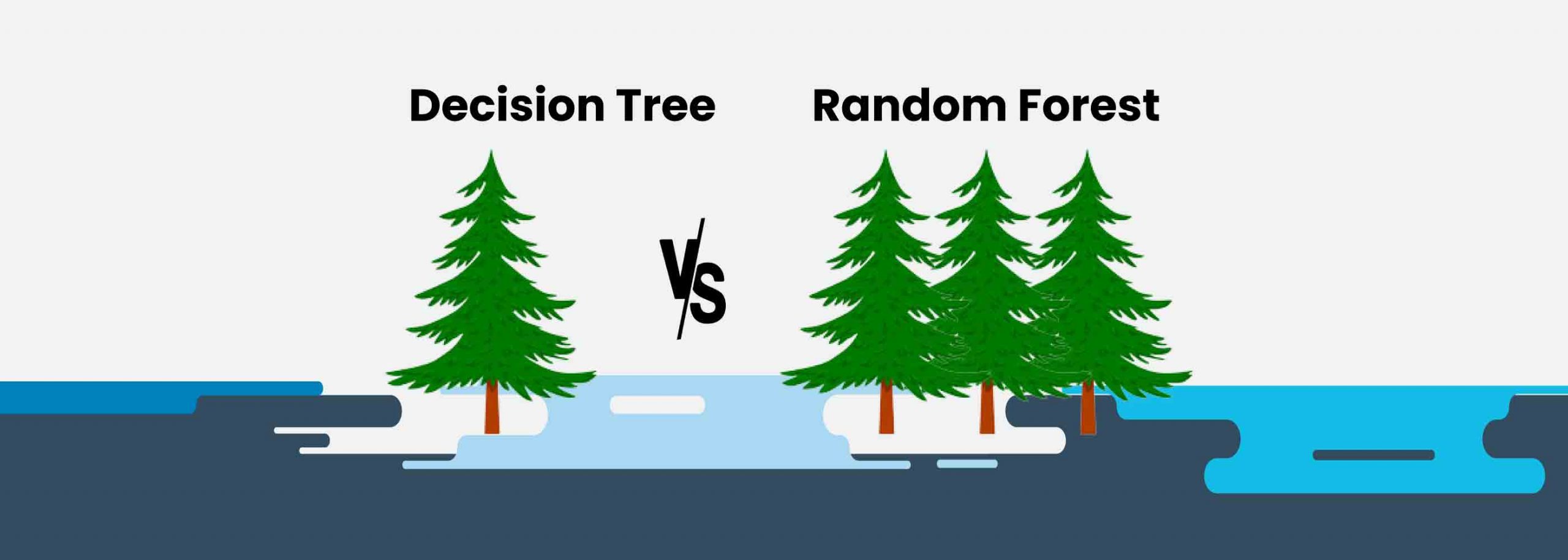
Why stick to one decision tree when you can have a whole forest of them? Random Forest and Decision Tree are two robust classification algorithms in the world of Machine Learning. Decision Tree utilizes a tree-like model of decisions and their possible consequences, while Random Forest is an ensemble of Decision Trees. Understanding the fundamentals of these algorithms is crucial for professionals and enthusiasts alike. Moreover, a comparative study between these two helps us comprehend which one would fit perfectly in a particular task. Let’s dive deeper into Random Forest and Decision Tree and discover which one stands tall as the winner of this classification conundrum.
Decision Tree
Are you tired of long and confusing decision-making processes? Look no further than Decision Trees! This algorithm is perfect for those who love clear, actionable steps. It works by breaking down a dataset into smaller and smaller subsets, with each division being based on a specific feature. And the best part? It’s easy to interpret! But, like everything, there are pros and cons. On one hand, Decision Trees are easily understandable and can work well with both numerical and categorical data. On the other hand, they tend to overfit and can become unstable with small inputs. So, while Decision Trees may be quick and easy, be sure to keep their limitations in mind. Need some examples? Decision Trees are often used in finance to classify customers’ credit risks, and in medicine to diagnose diseases. However, be cautious when using Decision Trees for large datasets as they can quickly become ineffective. So, whether you’re looking to make a quick decision or just love well-organized data, Decision Trees may be the perfect algorithm for you!
Random Forest
Random Forest is a versatile and powerful classification algorithm. It is an ensemble algorithm that creates multiple decision trees and combines them to produce accurate predictions. The primary advantage of Random Forest is its ability to avoid overfitting, which is often a significant problem with decision trees. However, Random Forest is not without limitations. The algorithm is more complex than decision trees, which means that it takes longer to train. Additionally, the model is not as interpretable as decision trees. It can be challenging to understand how the algorithm arrived at a particular prediction. Despite these limitations, Random Forest is an excellent algorithm for many applications. It can handle large amounts of data and is less susceptible to overfitting than decision trees. Some real-world examples of applications where Random Forest works well include detecting fraudulent transactions, predicting customer churn, and identifying spam emails.
Comparison between Decision Tree and Random Forest
Decision trees and random forests are two of the most popular algorithms used for classification. However, each has its pros and cons, making it difficult to determine which one is better. Below, we will compare decision trees and random forests, strictly based on the following parameters. Accuracy: Decision trees tend to have high bias, resulting in low accuracy for complex datasets. On the other hand, random forests have low bias and low variance, resulting in high accuracy even for complex problems. Overfitting: Decision trees are prone to overfitting, whereas random forests are not. The reason is that decision trees are designed to fit the training data precisely, resulting in over-reliance on the training dataset. In contrast, random forests use multiple trees, so the bias is reduced, and the variance is minimized. Training time: Decision trees are relatively quicker to train than random forests. The reason is that decision trees only have to consider one variable at a time, whereas random forests have to consider multiple variables. Interpretability: Decision trees have the advantage of being easy to interpret, whereas random forests lack interpretability. The reason is that decision trees are simple structures that can be represented graphically. On the other hand, random forests have multiple trees that work together, making it difficult to understand how the algorithm arrived at the prediction. Scalability: Random forests are not scalable, whereas decision trees are. The reason is that random forests have multiple trees that need to be trained, making it more computationally expensive. In contrast, decision trees only have to consider one variable at a time, making them more scalable. In conclusion, both decision trees and random forests have their pros and cons. Therefore, choosing between the two depends on the dataset you are working on and your goal. If accuracy and overfitting are critical, choose random forests. If interpretability and scalability are crucial, choose decision trees. Ultimately, the choice between the two will depend on the specific requirements of the project.

When to use Decision Tree and when to use Random Forest?
When it comes to choosing between Decision Tree and Random Forest, it all depends on the context. Decision Tree is ideal when we want a fast and easy solution. It is perfect for small datasets and can be used for obtaining a quick understanding of data. However, Decision Tree can suffer from overfitting, which means it may not generalize well when presented with unseen data. Random Forest, on the other hand, is ideal when we need higher accuracy and more reliable results. It can still work well even with noisy and missing data, making it more robust than Decision Tree. In situations where we want varying trees to avoid overfitting, Random Forest is the way to go. In the real world, Decision Tree is used in multiple applications, including medical diagnosis, customer profiling, and credit scoring. Random Forest is applied more in banking, marketing, and e-commerce. For instance, a bank might use Random Forest to classify customers based on their income or buying power. Ultimately, the choice between Decision Tree and Random Forest comes down to how much time, effort, and expertise one has in solving a particular problem. A Decision Tree is the way to go for ease and speed, while Random Forest is perfect when real-time applications require higher accuracy and reliability.

Conclusion
In summary, both Random Forest and Decision Tree have their strengths and weaknesses. Decision Tree is easy to interpret and implement, but it is prone to overfitting. On the other hand, Random Forest has good accuracy, scalability, and less tendency to overfit, but it is hard to interpret. When to use Decision Tree or Random Forest depends on the nature of the problem you are working on. In general, Decision Tree is best for simple problems where interpretability outweighs accuracy. On the other hand, Random Forest is best for complex problems where accuracy is more important than interpretability. Overall, both Random Forest and Decision Tree offer different benefits, and the choice depends on the requirements and constraints of the problem. Keep in mind the comparison parameters while selecting the best method.