

Introduction
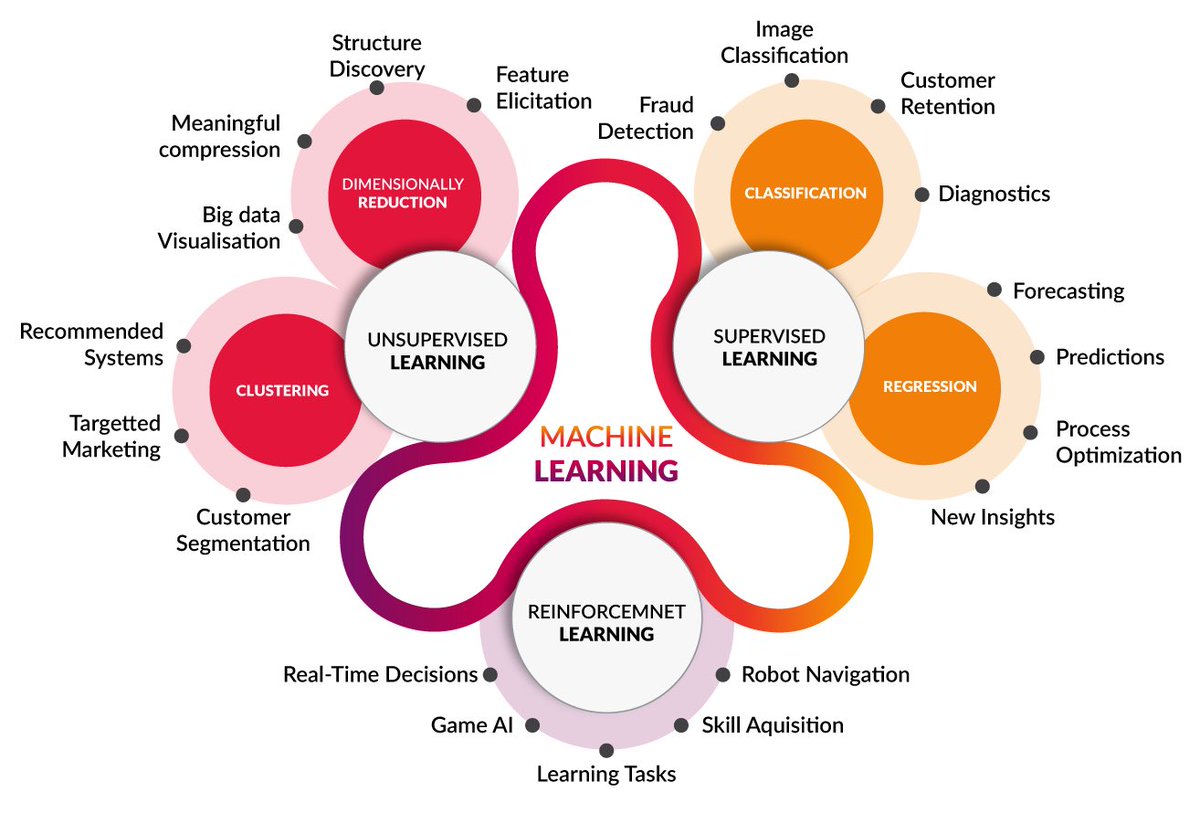
Machine learning is the set of algorithms and statistical models that computer systems use to perform specific tasks without explicit instructions. There are different techniques of machine learning- supervised, unsupervised, and reinforcement learning. Each has unique attributes and applications.
Supervised Learning
Supervised learning is the most commonly used technique in the industry. In supervised learning, the algorithm learns from labeled data. Here, the data is labeled with its correct output. The algorithm develops a model, i.e., a hypothesis function for mapping the input to output. The algorithm iteratively adjusts the model parameters to minimize the error between predicted and actual output. It is most commonly used in applications like image recognition, speech recognition, spam detection, and stock price prediction.
Types of Supervised Learning:
There are mainly two types of supervised learning: – Regression: When a model predicts a continuous output, it’s called regression. For example, predicting a house’s price based on its location and size. – Classification: When a model predicts a discrete output like true/false, yes/no, 0/1, etc., it’s called classification. For example, predicting whether an email is spam or not.
Unsupervised Learning
Unsupervised learning is the process of machine learning without having any labeled data. Here, the algorithm learns from unlabeled data. It identifies hidden patterns and relationships between data and groups similar data together. Unsupervised learning mostly involves clustering and dimensionality reduction. It is used usually in applications like recommender systems, anomaly detection, fraud detection, and customer segmentation.
Types of Unsupervised Learning:
There are are mainly two types of unsupervised learning: – Clustering: Finding patterns or groupings in datasets is clustering. It is used in customer segmentation, image segmentation, etc. – Dimensionality Reduction: Sometimes data has too many features that cause problems in computations. Dimensionality reduction decreases the features of the dataset.

Reinforcement Learning
Reinforcement Learning is a subset of Machine Learning and AI that focuses on using software agents to evaluate and learn from experience. It helps the agent learn to make decisions in an environment based on the feedback it receives from the environment. Reinforcement learning is used primarily in applications where the artificial agent has to interact with the environment to reach a given goal.
Types of Reinforcement Learning:
There are mainly two types of reinforcement learning: – Positive Reinforcement: occurs when a behaviour is reinforced with a reward or incentive. – Negative Reinforcement: occurs when a behavior is reinforced by the removal of an adverse stimulus.
Conclusion
Machine learning is a vast field with the potential of transforming every industry. Knowing the type of machine learning that best fits your problem is essential. Supervised learning is useful when there is labeled data, while unsupervised learning is the way to go when there is no labeled data. Reinforcement learning can be used when the agent has to interact with the environment to achieve a given goal.
Remember to evaluate carefully which type applies to your machine learning problem.
The reader is now set and can explore more about the differences between these types of Machine Learning, discover where they can be applied in the industry, and improve their knowledge and abilities in the area.

Hi, this is a comment.
To get started with moderating, editing, and deleting comments, please visit the Comments screen in the dashboard.
Commenter avatars come from Gravatar.